 الحياري الإقتصادي اقتصاد سهل يفهمه الجميع

After a turbulent 2025, the global economy is attempting a delicate balancing act in 2026. We are seeing a world divided by “sticky” inflation in the West and “cheap” exports from the East, all while a massive AI-driven investment boom reshapes the financial landscape.
1. The Tale of Two Inflations
The global economy is currently a study in contrasts:
The US Struggle: Inflation remains stubborn, partly due to the friction of trade tariffs. However, the Federal Reserve is still expected to cut rates more aggressively than many anticipate.
The Chinese Pivot: Facing weak domestic demand, China is pivoting its exports toward Asia, Europe, and South America. By exporting “cheap goods,” it is effectively exporting deflation, which helps cool prices for the European Central Bank.
2. The Great AI Gamble
AI remains the headline driver of growth, but the narrative has shifted to a phase of “inefficient spending”. Tech “hyperscalers” are expected to issue a staggering $700 billion in debt to fund this revolution. The risk remains that labor market disruptions could intensify if the demand for these massive investments weakens.
3. Market Performance: Winners and Divergence
As of early February 2026, we are seeing a significant “broadening” of the bull market where quality companies with secular tech tailwinds are favored. The performance across different regions tells a story of local growth versus global headwinds:
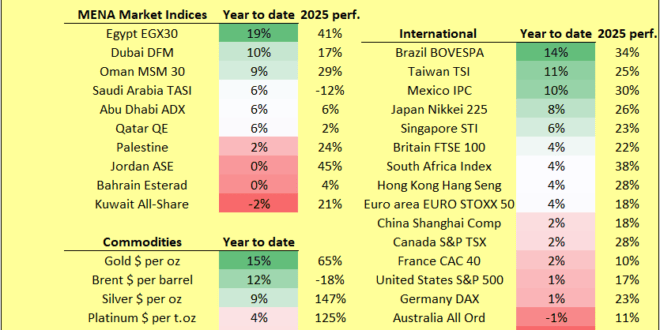
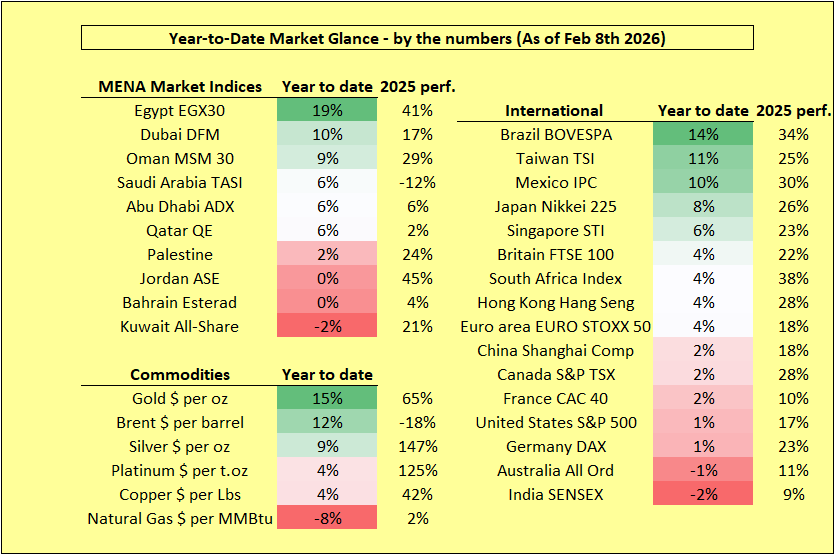
The High Flyers: Egypt (EGX30) leads the pack with a massive +19% year-to-date return, followed by Brazil (BOVESPA) at +14% and Taiwan (TSI) at +11%.
The Safe Havens: Gold has continued its momentum from a record 2025, sitting at +15% for the year so far.
The Steady Ground: The S&P 500 remains modest at +1%, while markets like Jordan (ASE) and the Abu Dhabi Index (ADI) remain flat at 0%.
4. Gold Shines While Oil Slips…for now
The commodities market is highlighting the global policy uncertainty:
Gold: Currently struggling to cross confidently the psychological $5,000/oz, Gold remains the ultimate “golden hedge”. Even small reallocations by global portfolios are causing outsized price impacts. Volatility remains in the short term. Hedge in the long term.
Oil: Brent crude is facing a supply-demand imbalance, with forecasts suggesting a slide from $71 down to $55 per barrel—a 22% decline. However, realistically and surprisingly oil price is showing resilient strength.
5. Sustainable Finance and the “Currency Kicker”
The way the world moves money is structurally changing. Green bond issuance is forecasted to hit $850 billion this year, with the MENA region playing a key role through projects like Jordan’s solar initiatives.
Furthermore, the US Dollar is currently ~15% overvalued. For international investors, any potential depreciation of the dollar could act as a “currency kicker,” significantly boosting returns for non-US investments.
What Does This Mean for You?
The strategy for 2026 is one of selection over momentum.
Focus on Earnings: Earnings growth will be the primary engine for stock returns this year.
Diversify: Declining correlations across global markets make diversification more valuable than ever.
Watch the Pivot: Keep an eye on the “Great Policy Pivot” as central banks continue their easing cycles, albeit less aggressively than last year.
The Bottom Line: 2026 is a year for being selective and watching for idiosyncratic factors. Whether it’s the AI boom or the surge in gold, or a surprise rise of oil price, quality and strategy are the keys to navigating this shifting landscape.